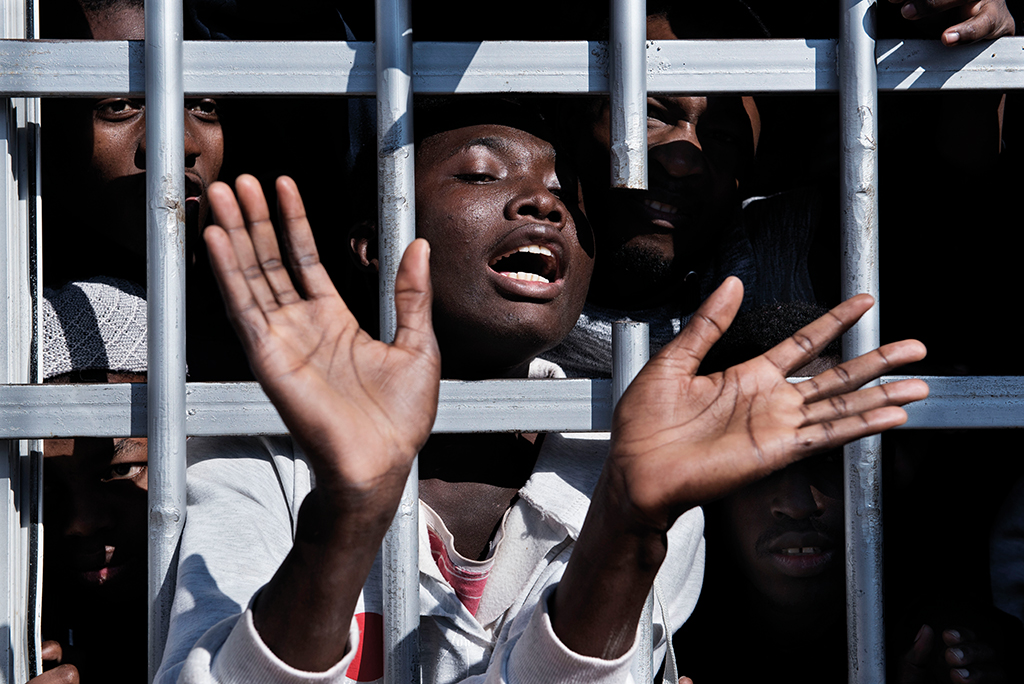
A migrant gestures from behind the bars of a cell at a detention centre in Libya, Tuesday 31 January 2017. The detention centre was constructed in 2006 following an agreement between the Italian and Libyan governments in an attempt to stem the flow of migrants reaching Italy. When UNICEF visited the centre on 31 January 2017, the population consisted of 27 women (four of whom were pregnant), one 11-month old child, a four year old, as well as 1,352 men – of which 250 were under the age of 16. The centre is at the crossroads of areas controlled by different militias fighting with each other. For this reason it is a very dangerous centre, for officers who work there and for migrants in detention. The detention centre is currently managed by the Libyan National Army, and most migrants remain there for a period of 8 to 10 months according to the manager Abdalhamad Altunisa. “Children are often alone, they cross 2000 kilometres of desert without their families, and they are rescued at sea without documents”, said Altunisia “this makes it difficult for us to know their real nationality and age. Before 2014 we brought them back to the border between Nigeria and Libya to take them back to their countries, but after the last civil war it was much more difficult. Those areas are dangerous even for us”. Migrants who were being held in the cells said they are rarely allowed out. Many of the those being held are sick, and some detainees are said to have passed away because they have no access to medical care. The director of the centre, Altunisa, said “the official government [of Sarraj] does not give us the money to pay salaries and to pay those who bring us food. So often we do not have enough food or drinking water. This winter was particularly cold and in recent weeks 15 migrants froze to death.”
Libya is a country in turmoil. Since 2014 security is precarious, living is hard, and violence is commonplace. The country is riven with militias in conflict with each othe

 Eccoci!

